
Sustainability
Sustainability is part of our strategy. Our operations are based on sustainable
practices, which we also expect from our subcontractors and partners. DMC’s
sustainability programme is based on the UN Sustainable Development Goals and we
have identified four areas of our business through which we can support their
implementation. In recent years, climate change and measures to combat it have been
at the heart of our sustainability operations.
Good health and well-being

Gender equity
Climate action
Decent work and economic growth
Our sustainability strategy includes environmental sustainability, economic
sustainability, and social responsibility matters. Environmentally, we have achieved carbon-neutral production as the first operator in Finland to do so in this industry sector
at the beginning of 2021. Zero emission production is a goal for which we are doing
everything we can. We use green electricity and biofuels whenever possible. We
provide lot of remote productions, and for that we have vehicles in north, south, east and west. Our new premises in Helsinki, has been built in accordance with the
Excellent rating of the international BREEAM environmental certification. For OB- productions we use reasonable routes and Neste MyDiesel whenever it is possible.
Most of our diesel vehicles are EUR 6 class. We are able to offer carbon-neutral
production today as we compensate for the remaining carbon footprint through Nordic
Offset.
Our sustainability strategy includes environmental sustainability, economic
sustainability, and social responsibility matters. Environmentally, we have achieved
carbon-neutral production as the first operator in Finland to do so in this industry sector
at the beginning of 2021. Zero emission production is a goal for which we are doing
everything we can. We use green electricity and biofuels whenever possible. We
provide lot of remote productions, and for that we have vehicles in north, south, east
and west. Our new premises in Helsinki, has been built in accordance with the
Excellent rating of the international BREEAM environmental certification. For OB-
productions we use reasonable routes and Neste MyDiesel whenever it is possible.
Most of our diesel vehicles are EUR 6 class. We are able to offer carbon-neutral
production today as we compensate for the remaining carbon footprint through Nordic
Offset.
For us, all people are equal regardless of age, gender or ethnicity. We follow this
principle in hiring people and offer staff equal opportunities for self-development. For
us, it is important that gender equality extends to decision-making and is reflected in
both board and management teamwork. The company also has a bicycle benefit.
Environmental measures and targets – carbon footprint
Reducing carbon dioxide emissions has been part of DMC Production’s strategy since
2018. Carbon footprint management is an essential part of any responsible TV
production. Carbon footprint is an indicator for organization’s climate impact. The most
common and known way to calculate organization’s carbon footprint is by following
international Greenhouse Gas Protocol’s guidelines.
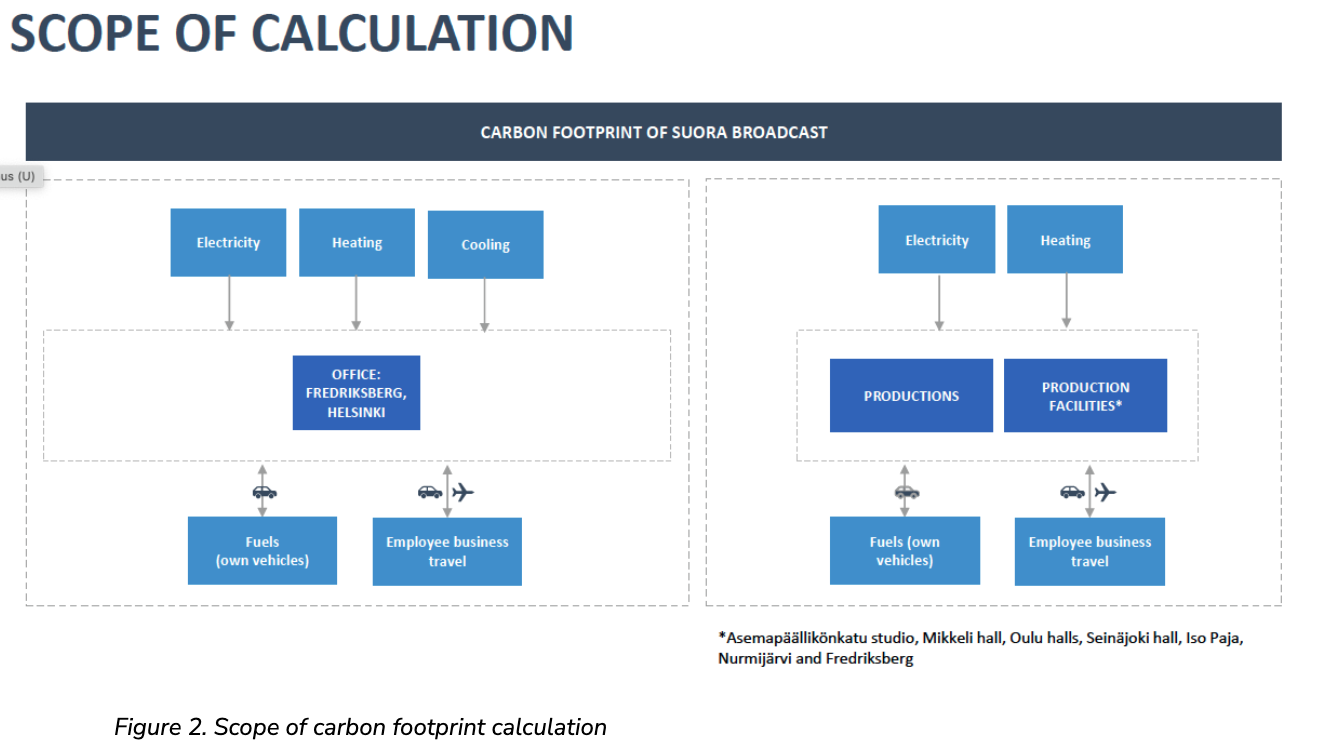
First carbon footprint calculations were made in 2019 and following in 2021, 2022 and
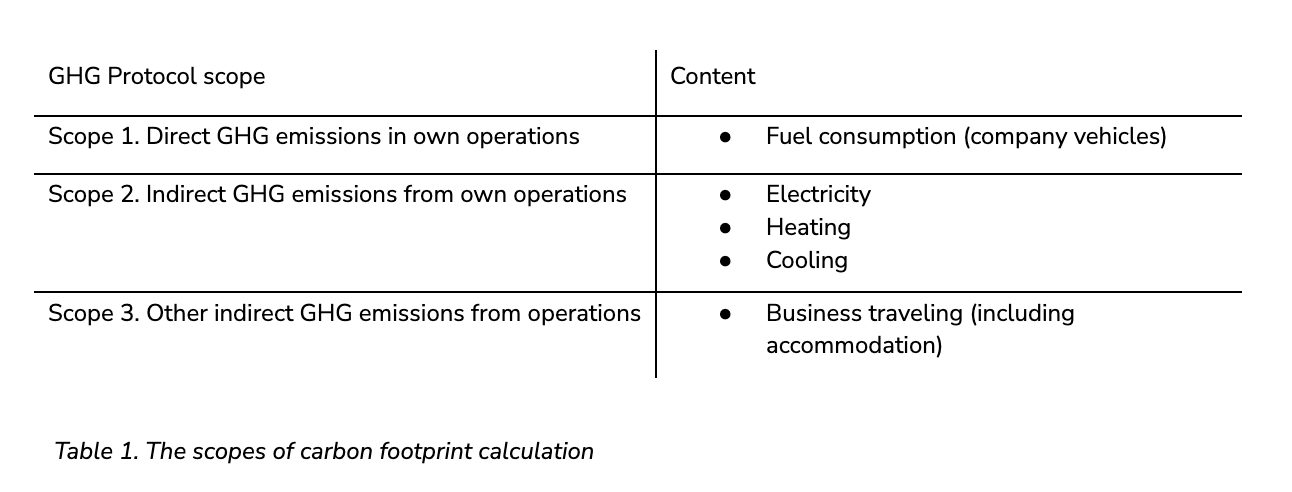
2023 by Nordic Offset Oy. The calculation considers the mandatory scopes 1 and 2 in
accordance with the standard and, where applicable, the most significant emission
sources from the voluntary scope 3 were included in the calculation.
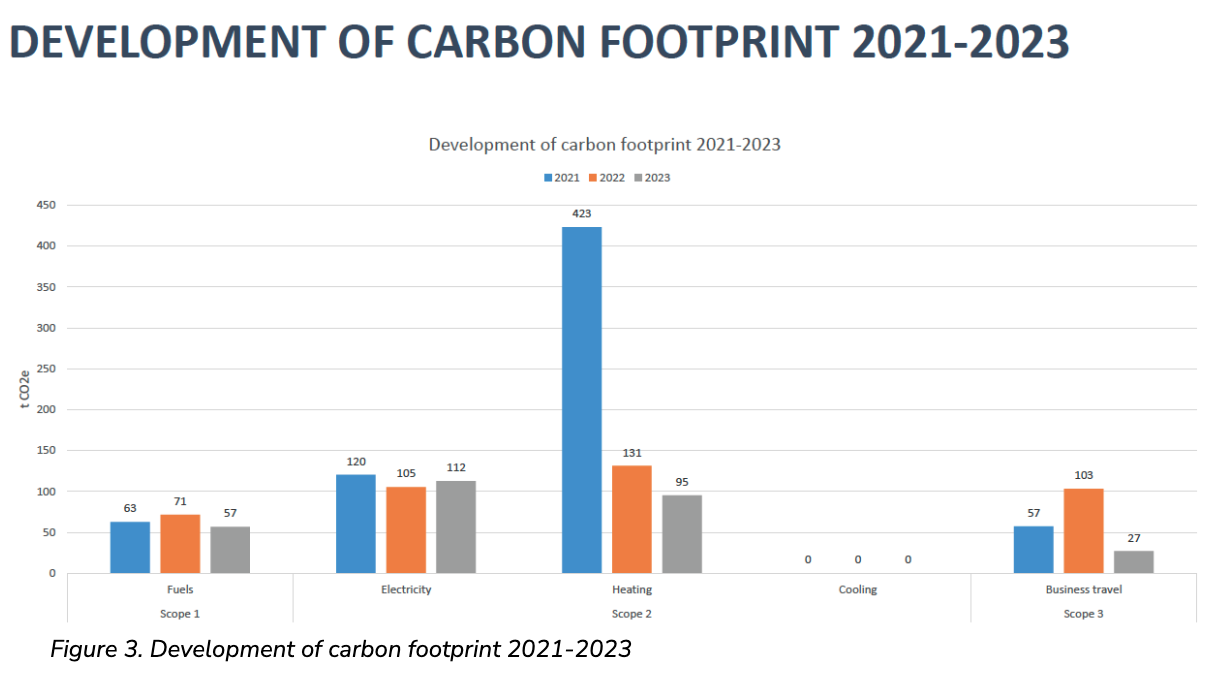
Total carbon footprint of Suora Broadcast was 291t CO2e in 2023. Our carbon footprint decreased by 50,1 % in 2023 compared to 2022. Compared to the baseline year (2019), carbon footprint has decreased by 67% during the years. Especially emissions from heating had significantly dropped (-263t CO2e) between 2022 and 2023. The main factor explaining this change is that in 2022 Iso Paja’s office produced 267t CO2e emissions from heating, but the office was not in use 2023.
The biggest share of the emissions came from scope 2 (71%). Electricity consumption was the biggest source of emission producing 113t CO2e of the total carbon footprint (39%). Scope 1 accounted for 20% and scope 3 for 9% of the total carbon footprint. When comparing offices and productions, the productions formed the bigger emissions (total 253t CO2e) while the offices accounted for 38t CO2e (13% of the total carbon footprint).
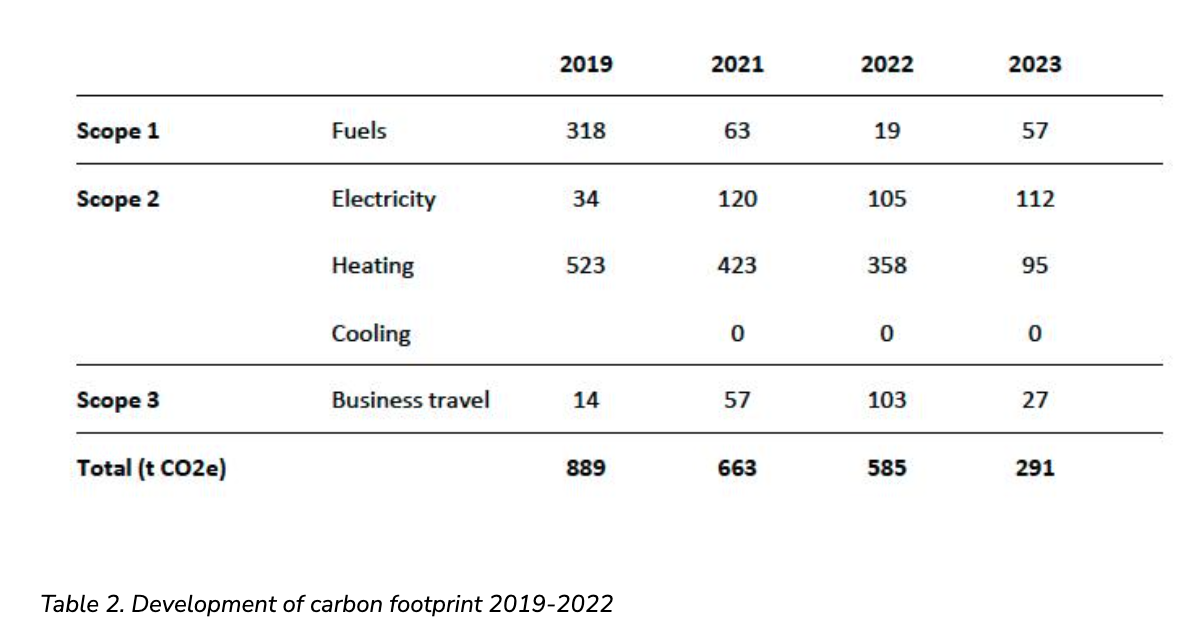
What is presented above is just a part of the actual report but gives an idea what is included in the calculations. The key findings identified how we have managed to achieve carbon neutrality are:
- Remote productions: The most sustainable way to produce TV productions. Increase number of remote productions as much as possible.
- HVO (Hydrotreated Vegetable Oil): Renewable fuel in any vehicle that still runs with combustion engine.
- Environmentally friendly vehicles: new vehicles will run with electricity, gas or any other sustainable energy.
- Green energy: all energy bought (heating, electricity, etc.) is green energy. Energy recovery of heating etc. to reduce emission.
- Employee bicycling: electric bicycles bought and a bicycle benefit to reduce work travel emissions.
- Gold Standard compensation: Gold Standard certified destinations as we still need to pay compensation to achieve carbon neutrality.
Continuous work towards more environmental productions still continues as a part of our strategy. In fact, Carbon footprint report always includes the next steps and ideas.

