
Original article written by Niklas Eckstein for mebucom.
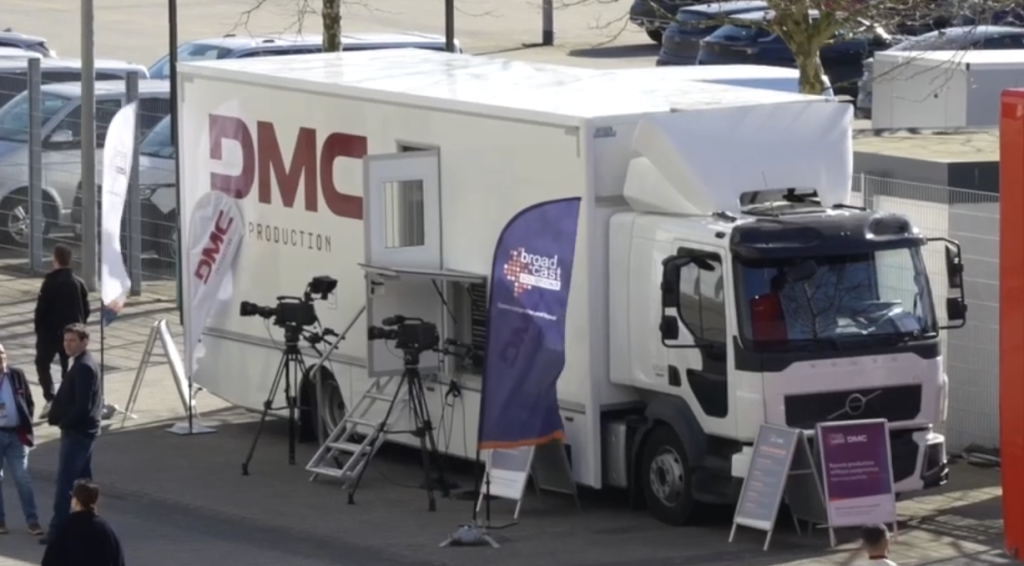
A new production concept from DMC Production and Broadcast Solutions Group challenges traditional ideas of what an outside broadcast truck needs to be. Built around the Grass Valley AMPP platform, the vehicle rethinks how live productions can be processed and controlled.
Rethinking the Remote Production Model
Anyone familiar with remote production knows the classic REMI model. Camera signals travel from the venue to a broadcast center, the show is produced there, and the finished signal is distributed from there. The model works well, but it requires large amounts of bandwidth and often dedicated connectivity.
DMC Production approaches the problem differently.
Instead of sending all camera feeds to a central facility, the processing happens directly at the venue inside the truck. Video switching, replay, audio mixing, and multiviewer generation run on Grass Valley AMPP servers installed in the vehicle racks. Remote production teams then connect to the system from control rooms in Helsinki and Hilversum.
Those remote galleries do not receive individual camera feeds. Instead, they receive a low latency multiviewer stream and send control commands back to the system.
As Jens Envall, Chief Innovation Officer at DMC Production, puts it: “Processing happens where the event takes place, and we control it remotely.”
Inside the Reverse Remote Production Truck
Technically, the vehicle is built around the cloud native Grass Valley AMPP production platform.
Inside the truck are two main equipment racks plus part of a third rack. Most of the space is taken up by the AMPP servers that run the production environment. Compared with a traditional OB truck, the amount of dedicated hardware is relatively small.
The system supports up to 16 Grass Valley cameras via XCUs, along with 32 additional external SDI signals through stage boxes. Core production functions including video switching, replay, audio mixing, and multiviewer generation run entirely on the AMPP infrastructure.
The interior layout reflects the streamlined architecture. Instead of a large gallery area, the vehicle contains three workstations in a clean, compact space. These can be used for smaller productions where a director or a small team may still want to operate on site.
The rear of the vehicle houses the technical racks and storage.
Running a Production on 100 Mbit/s
One of the more surprising aspects of the setup is the bandwidth requirement. Despite supporting a full multi camera production, the system operates on roughly 100 Mbit/s of standard internet connectivity.
Around 25 Mbit/s is used for the platform and control data, another 25 Mbit/s for monitoring through WebRTC multiviewer streams, and up to 25 Mbit/s for program output delivery via SRT if required. Even with those components running, the system still retains additional headroom.
The remote control rooms in Helsinki and Hilversum are equipped with full hardware panels, allowing operators to work in a familiar production environment. These include a Maverick vision mixer panel, audio fader surfaces, a LiveTouch replay controller, and camera control panels.
Operators monitor the production through the same multiviewer layout generated inside the truck and delivered via WebRTC. SRT streams from the remote locations mainly serve as return feeds for verification.
Designed for Flexibility and Future Scaling
DMC Production primarily plans to use the truck for sports broadcasting, which represents the company’s core business. At the same time, the setup can also support smaller entertainment productions.
A production with a limited number of cameras could place a director on site, record ISO feeds from all cameras using AMPP’s elastic recording capabilities, and hand the material over for post production afterward. A small NAS system is planned for the truck to support local storage workflows, alongside the option to upload directly to cloud storage.
For simpler productions, audio mixing can be handled directly within AMPP. For more demanding events, the truck will integrate a Calrec audio solution.
Johannes Lanyi, Solution Architect at Grass Valley, explains the reasoning:
“The audio engineer will not use a mouse or a touchscreen. Tactile control is non negotiable.”
At the moment, the vision mixer supports up to 32 inputs, a limit determined by the computing capacity of the current AMPP server generation. Envall expects that limit to increase as newer hardware becomes available. In the longer term, multiple servers could operate together through grid technology, effectively functioning as a single virtual production system.
A Broader Industry Shift
Envall sees the truck as part of a wider shift in broadcast technology.
“Historically, the broadcast industry moved away from dedicated hardware more slowly than other sectors. That’s changing fundamentally. Broadcasting is now following the same path as other industries toward software based solutions and service oriented infrastructure.”
In that sense, the DMC Production vehicle is not just a new OB truck concept. It offers a practical example of how software driven production architectures may reshape the way live content is produced in the years ahead.

